
Hosur has grown fast. Auto ancillaries, EV component manufacturers, electronics units - the industrial belt along NH44 runs two and three shifts, and electricity consumption is constant and heavy. For most factory owners here, power has always been a cost of doing business. What has changed recently is how that cost is calculated.
What the ToD tariff actually means for your factory
Tamil Nadu's electricity regulator TNERC introduced Time of Day (ToD) tariffs for industrial consumers with a maximum demand above 10 kW, effective April 2024. The billing structure is no longer flat - it varies based on the hour of the day.
Under the current TNERC tariff order, here is what industrial consumers in Tamil Nadu pay:

Peak hours cover eight hours of the day - the morning startup window and the evening production window. For a factory running day and evening shifts, that is a large share of total consumption hitting the highest rate. On top of this, demand charges now stand at ₹608 per kVA per month, billed on your highest recorded demand during the period - even if that peak lasted only a few minutes.
The practical effect: two or three line items on your bill that did not exist two years ago, each adding to a total that has quietly climbed 20–30% without any change in your actual consumption.
How most factories are managing it - and the limits of each approach
Shifting some production to night hours works in theory. In practice, it means renegotiating shift timings, managing labour logistics, and reorganising machine schedules - all for partial relief, because not everything can move.
Running a diesel generator during peak hours brings its own problems. Diesel costs around ₹22–25 per unit all-in, which is more than double the peak-hour grid rate. It also means maintenance, fuel storage, noise, and emissions - costs that rarely show up in a simple per-unit comparison but add up over a year.
Most factory owners end up absorbing the cost. Margins tighten, and the bill becomes a fixed irritant that gets reviewed every month but never really resolved.
What a Battery Energy Storage System does differently
A BESS is essentially a large battery bank installed at your facility. It charges during cheaper hours and discharges during expensive ones, so your factory continues to operate normally while the source of power shifts based on cost.
The mechanics for a Hosur factory are straightforward:
During off-peak hours (night or mid-afternoon), the BESS charges from the grid at ₹7.13–₹7.50 per unit
During peak hours (6–10 AM and 6–10 PM), the factory draws from the battery instead of the grid, avoiding the ₹9.38 rate entirely
The BESS can also reduce the demand spike that drives up your monthly kVA charge
The per-unit cost of electricity delivered through a BESS works out to the source rate plus approximately ₹2.50–3.00 per unit for the system - still significantly below peak-hour grid rates.
Cost comparison: grid-only vs BESS for peak-hour consumption
The chart below shows the effective per-unit cost across different scenarios for a factory with significant peak-hour load.
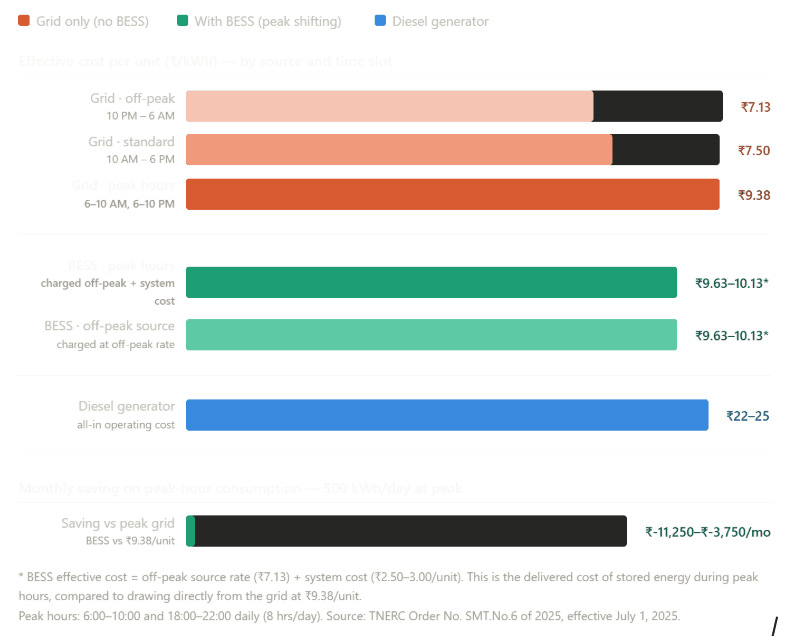
As battery prices have dropped over 80% in the past decade, the economics have shifted considerably. For factories in the 100 kW to 5 MW load range - which covers most of Hosur's mid-size manufacturing units - the payback period on a BESS investment has come down to a range where the numbers typically work.
A practical starting point
The right way to evaluate this is to pull three months of electricity bills and map out when your consumption is highest. If a significant portion lands in the 6–10 AM or 6–10 PM windows, the case for BESS gets stronger quickly. The more your operations are concentrated in those hours, the larger the saving.
For factories that also have rooftop solar, BESS adds another layer of value - storing excess daytime generation for use during the evening peak, which would otherwise mean drawing from the grid at ₹9.38 per unit.
Save on ToD Tariffs now! Reach out to TurnoVolt to learn more.